


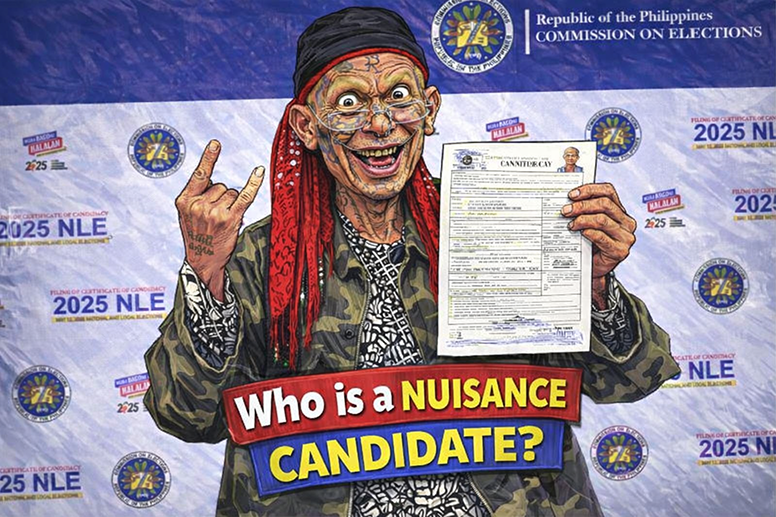
Electoral Integrity Within Constitutional Limits
The credibility of democratic governance depends not only on the freedom to vote but on the clarity of the choices presented to the electorate. Elections must remain accessible, yet they must also be structured in a manner that allows voters to exercise judgment without confusion or distortion.
Philippine election law addresses this institutional requirement through the doctrine of the nuisance candidate. Properly understood, the rule is neither exclusionary nor punitive. It is a constitutional mechanism intended to protect the faithful expression of the sovereign will.
The Supreme Court has long acknowledged the State’s compelling interest in preserving orderly and rational elections, while at the same time guarding the citizen’s fundamental right to seek public office. The resulting jurisprudence reflects careful calibration rather than regulatory aggression.
The ballot must remain open, but it cannot be allowed to descend into incoherence.
Statutory Architecture
Section 69 of the Omnibus Election Code authorizes the Commission on Elections (COMELEC) to deny due course to or cancel a Certificate of Candidacy upon proof that the filing was made:
- To place the election process in mockery or disrepute;
- To cause voter confusion, often through similarity of names; or
- Under circumstances that demonstrate the absence of a bona fide intention to run for office.
The controlling inquiry is intent. The doctrine does not concern itself with a candidate’s political strength, organizational reach, or probability of success. It asks a narrower but more constitutionally significant question: whether the candidacy is genuine or merely instrumental.
Courts have repeatedly emphasized that the power to exclude must be exercised with discipline. Administrative convenience cannot justify the erosion of political rights.
Constitutional Guardrails
The Court has drawn clear boundaries around the nuisance doctrine to prevent its transformation into a proxy for political screening.
Financial Capacity
In Marquez v. COMELEC, the Court rejected financial incapacity as a standalone basis for disqualification. To hold otherwise would impose a property qualification inconsistent with republican equality. Public office is not reserved for those with superior economic resources.
Popularity
Obscurity does not equate to bad faith. Declaring a candidate a nuisance simply because he or she is unknown risks converting elections into managed popularity contests. The Constitution assigns the assessment of electability to voters, not regulators.
Political Affiliation
Party membership is not a legal prerequisite for seriousness of intent. Independent candidacies remain a legitimate channel of democratic participation, and history offers repeated examples of reform emerging from outside traditional political structures.
Taken together, these rulings articulate a deeper principle: regulation must target deception, not disadvantage.
Procedural Discipline
A petition to declare a nuisance candidate parallels proceedings under Section 78 of the Election Code. The burden rests squarely on the petitioner, including the COMELEC when acting motu proprio, to establish the statutory grounds through substantial evidence.
Absent such proof, the respondent is under no obligation to demonstrate legitimacy.
This allocation is not merely procedural. It affirms that access to the electoral arena cannot be curtailed by conjecture, administrative preference, or subjective assessments of viability.
Administrative due process further requires that decisions be grounded in evidence, explained with clarity, and rendered in a manner that permits meaningful review. Electoral legitimacy depends as much on process as it does on outcome.
Legal Effect of a Nuisance Declaration
Once a declaration attains finality, the legal posture is unequivocal. The nuisance candidate is treated as though no Certificate of Candidacy had ever been filed. Votes cast in their favor are generally considered stray.
When confusingly similar names are involved, jurisprudence permits the crediting of votes to the legitimate candidate in order to approximate voter intent. The Court has nevertheless adopted a more exacting approach in multi-slot contests, cautioning against mechanical vote transfers that could result in double counting.
The guiding objective remains constant: fidelity to the electorate’s will must prevail over administrative simplicity.
Institutional Context
The persistence of nuisance candidacies is not an abstract concern. Modern elections confront expanding ballots, accelerated information cycles, and increasingly sophisticated methods of voter manipulation. Without a filtering mechanism, the risk is not merely logistical congestion but electoral distortion.
Yet the Court has been equally clear that the authority to exclude is not a license for arbitrariness. Excessive gatekeeping chills participation. Insufficient regulation invites disorder. Constitutional governance demands resistance to both tendencies.
What emerges from the jurisprudence is not a preference for restriction, but a commitment to disciplined inclusion.
Firm Point of View
Our firm approaches the nuisance candidate doctrine from the standpoint of constitutional equilibrium.
Election law is not designed to curate the political field according to perceived competitiveness. It exists to ensure that democratic choice remains authentic. The distinction is consequential. A candidate need not be formidable to be legitimate, but the candidacy must be real.
Regulators must therefore resist the temptation to substitute predictive judgment for legal analysis. Questions of popularity, campaign capacity, and electoral probability belong to the political sphere. The legal inquiry is confined to whether the candidacy was filed in good faith or as a vehicle for confusion, mockery, or strategic manipulation.
Equally important is the recognition that the nuisance doctrine protects not only voters but also serious candidates. Confusingly similar names, theatrical filings, and bad-faith candidacies dilute the informational value of the ballot and erode public confidence in electoral outcomes.
At the same time, the doctrine must never be deployed in a manner that narrows democratic space. The Constitution presumes political equality. Regulatory tools must operate with precision, supported by evidence rather than inference.
For institutions tasked with administering elections, the challenge is not simply enforcement but judgment. The ballot must remain accessible without becoming indiscriminate. It must be structured without becoming exclusionary.
In our assessment, the enduring instruction of the Court is straightforward: the law is unconcerned with whether a candidate can win; it is concerned with whether the candidacy is genuine.
That distinction preserves both electoral order and democratic openness.
Comments are closed